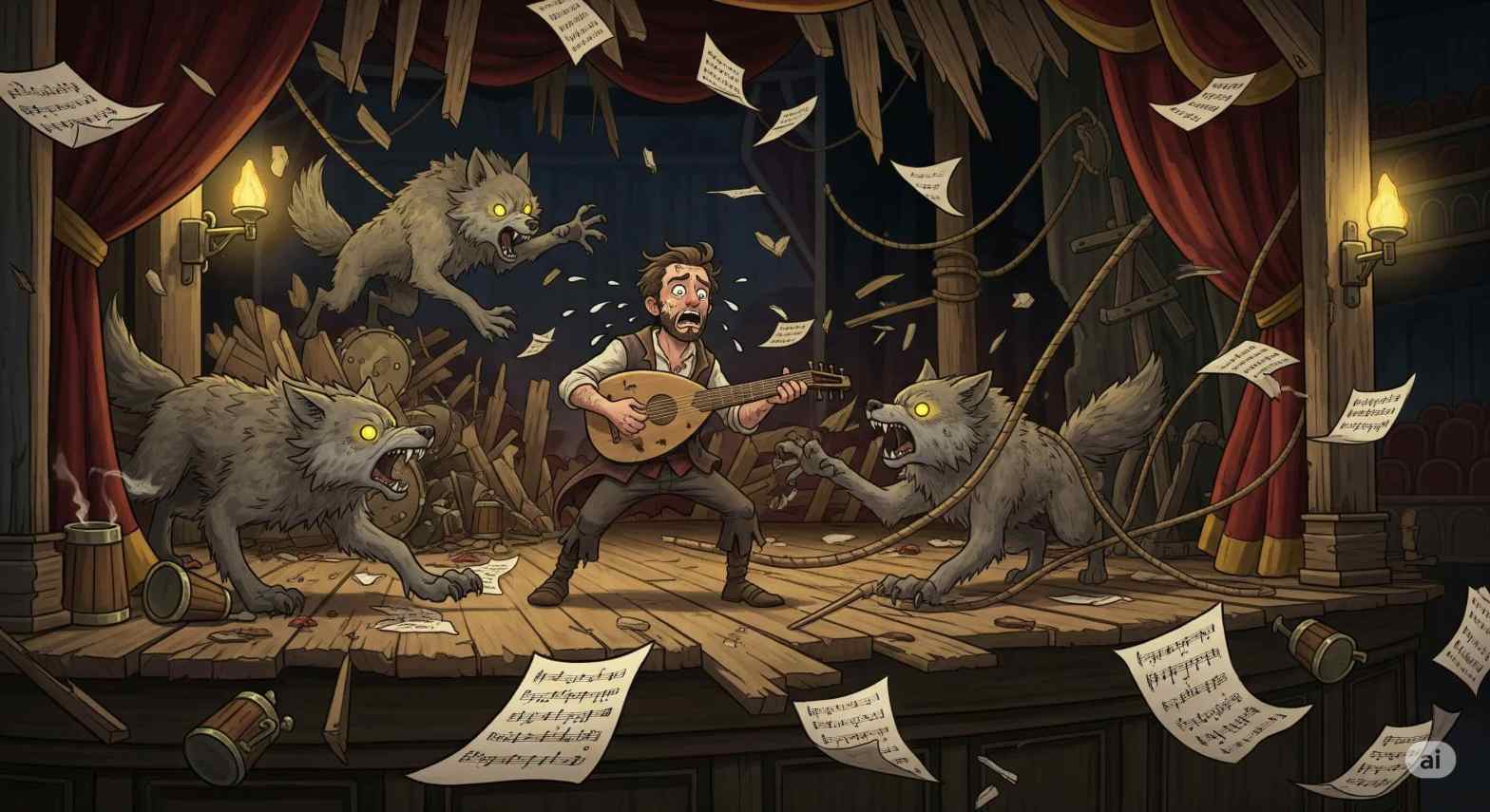
The discordant jangle of Clement Fossy’s instruments announced his approach long before his reed-thin frame appeared in the doorway of the Rusty Anchor tavern. Three lutes, two flutes, and a small drum bounced against the bard’s bony frame with each agitated step, creating a percussion that caused the tavern’s patrons to roll their eyes and sigh with annoyance. Fossy didn’t seem to notice. He was clearly preoccupied with something.
“You’re the adventurers, yes?” He puffed out his chest as he spotted the group of well-worn travelers nursing their ales in the corner. “The ones who cleared out those bandits on the north road?”
Kira, a half-elf ranger with keen eyes and a practical disposition, looked up slowly from her drink. “Depends who’s asking. And why you’re making such a racket.”
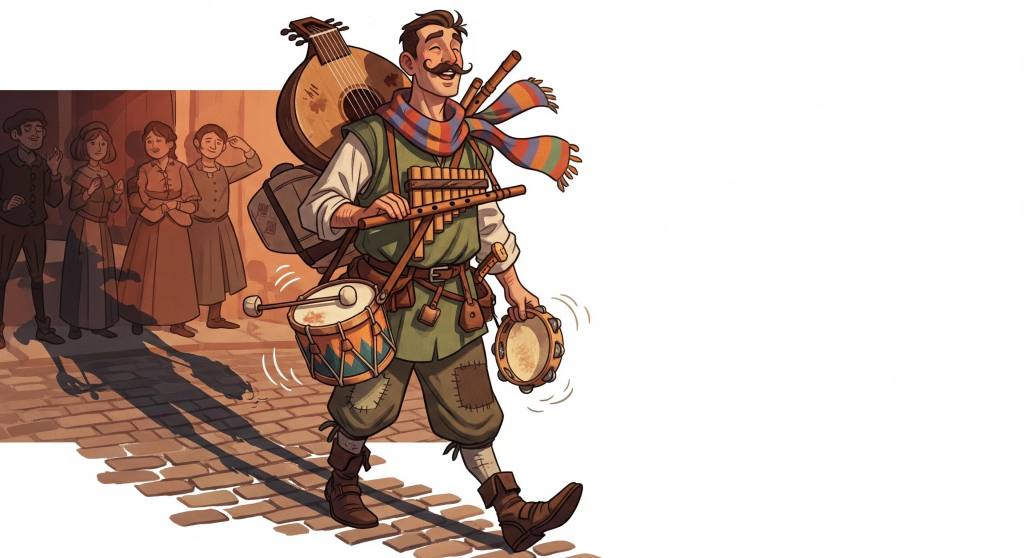
Fossy straightened himself with pride, his instruments clattering as he gestured wildly. “I am Clement Fossy, proud manager of the Bards’ Flophouse. And this—” he plucked a lute string that produced a sound like a dying cat “—is the sound a true artist makes.”
The dwarf fighter, Thorek, snorted into his beard. “Sounds more like musical torture to me.”
“Please!” Fossy’s voice rose above the tavern’s ambient noise. “You don’t understand. The flophouse is everything to us—to dozens of bards who have nowhere else to go. And that harpy landlord, Griselda Vogel, is going to destroy it all!”
Despite herself, Kira found her curiosity piqued. “What’s the Bard’s Flophouse?”
Fossy’s eyes lit up with the fervor of a true believer. “It’s a sanctuary! A place where art flourishes without the chains of commerce. Where a poor bard can sleep in the hallways and play their heart out on our stage, where—”
“Where nobody pays rent,” interrupted Mira, the group’s half-orc wizard, her tone dry as desert sand.
“Art transcends such mundane concerns!” Fossy protested, then deflated slightly. “Apparently, Griselda doesn’t see it that way.”
The fourth member of the party, Jasper—a human rogue with a silver tongue and nimble fingers—leaned forward with interest. “And what exactly are you proposing we do about this Griselda?”
“Not her directly,” Fossy said, lowering his voice and rubbing his hands together. “I have a plan. A brilliant plan. A plan that will save the flophouse and prove the power of true artistry once and for all.”
Thorek groaned. “I already don’t like where this is going.”
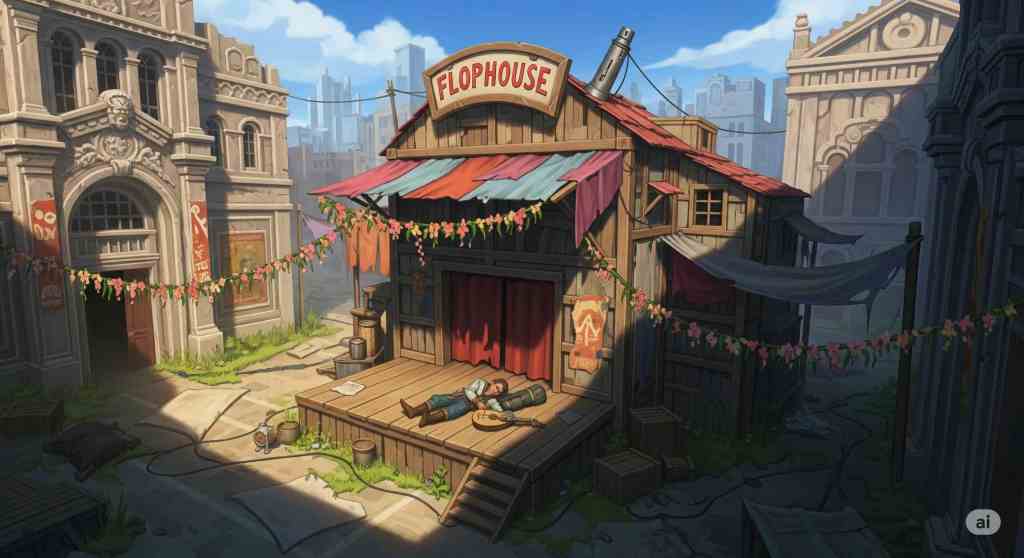
An hour later, the group found themselves following Fossy through the winding streets of the Theater District. The flophouse stood before them like a fever dream painted in desperate optimism—its weathered walls covered in tattered banners and cheap flowers that couldn’t quite hide the building’s advanced decay.
Inside, the place buzzed with chaotic energy. Bards sprawled across bedrolls in the corridors, their voices rising in practice scales that clashed with the melodies drifting from the practice rooms. The air was thick with the smell of unwashed bodies, instrument rosin, and dreams on the verge of expiration.
“Beautiful, isn’t it?” Fossy said, his voice reverent as they stepped over a sleeping lute player.
“It’s… something,” Kira admitted diplomatically.
They gathered in the common room, where twin fireplaces provided more smoke than warmth. Fossy perched on the edge of a chair that had seen better decades and fixed them with an intense stare.
“Here’s my plan,” he began, his instruments punctuating his excited gestures with jangled notes. “What draws crowds more than anything else?”
“Death?” suggested Jasper helpfully.
“Not exactly!” Fossy exclaimed, missing the sarcasm entirely. “Thrills! Adventure! And the possibility of death. I want to stage a performance with real monsters!”
The silence that followed was broken only by the distant sound of someone practicing what might charitably be called singing in the upper floors.
“Real monsters,” Mira repeated slowly. “Live monsters. On stage. With an audience. Have you ever been around real monsters before?”
“I have not, but I don’t see how that matters,” Fossy continued, gesturing so enthusiastically that his drum banged against the side of the table. “People pay good coin to see gladiators fight beasts in arenas. But what if instead of fighting beasts, I charmed beasts with music? Soothe the savage beast with song! It would be revolutionary! And a live audience would love it.”
“It would be suicide,” Thorek muttered.
“It would be art!” Fossy countered. “And profitable art, at that. Griselda couldn’t possibly shut us down if we were drawing capacity crowds every night.”
Kira exchanged glances with her companions. The plan was insane, but there was something endearing about Fossy’s desperate faith in his abilities. After a long sigh, she gave in. “Okay, Fossy — how are you planning to get the monsters?”
“Well,” Fossy said, suddenly looking sheepish, “I was hoping you might help with that part. You see, I know where to find them—there’s a cave system just outside town that’s supposedly full of creatures. But I’m not really the… adventuring type.”
“No kidding,” Thorek said, eyeing the bard’s complete lack of protective gear.
“I’ll split the profits!” Fossy added hastily. “After we save the flophouse, that is. This could be the start of a beautiful partnership. You bring the monsters, I tame them with song, and together…WE REVOLUTIONIZE ENTERTAINMENT!”

The caves turned out to be infested with dire wolves—magnificent, silver-furred predators with intelligence glinting in their amber eyes. It took considerable effort and more than a few close calls, but the group managed to capture three of the beasts using nets and Mira’s sleep spells.
“They’re perfect!” Fossy exclaimed when they returned, dancing around the caged wolves with manic glee. “Noble, dangerous, but not so exotic that the audience won’t recognize the threat. This is going to be magnificent!”
The performance was scheduled for the following evening. Word spread quickly through the Theater District—partly due to Fossy’s enthusiastic promotion, but mostly because news of impending disaster traveled fast in entertainment circles.
The small courtyard near the flophouse filled with curious spectators who packed every available space. Nobles rubbed shoulders with street performers, all drawn by morbid curiosity and the promise of witnessing either triumph or catastrophe.
Griselda Vogel herself sat in the front row, her stern face set in disapproving lines. She had clearly been dealing with Fossy’s grand plans for a long time, and tonight the play’s numbers would determine the flophouse’s fate.
“Ladies and gentlemen!” Fossy announced, his voice projecting across the gathered crowd. “Tonight, you will witness the power of music to transcend the barriers between civilization and wild nature!”
The crowd hushed as the cages were wheeled onto stage. The dire wolves paced restlessly, lethal as coiled springs, their eyes reflecting the stage lights like captured stars.
Fossy raised his primary lute—the one with the least-damaged strings—and began to play.
For a moment, it seemed like it might actually work. The melody was haunting, beautiful even, and the wolves seemed to calm slightly. The audience held its collective breath.
Then Fossy, carried away by his own performance, decided to add dramatic flourishes. He spun, he leaped, he played three instruments simultaneously. The theatricality was extraordinary.
It was also quite offensive to dire wolf sensibilities.
The largest wolf threw itself against its cage door with enough force to snap the hastily repaired lock. Its companions quickly followed suit, and suddenly the stage was alive with snarling, silver death.
“This is why we carry weapons,” Thorek observed, hefting his axe as the audience erupted in screams.
What followed was less a battle than a frantic game of keep-away, played on a collapsing stage with panicked wolves and an even more panicked bard. Kira’s arrows pushed the wolves back, while Mira’s magic kept the beasts from reaching the fleeing audience. Jasper darted between the chaos, herding civilians to safety, while Thorek stood his ground like a mountain of stubborn steel.
Through it all, Fossy continued playing, either in denial or delusion, his instruments creating a soundtrack of disaster that somehow made the entire scene even more surreal.
When the last wolf was finally caged, the stage resembled a war zone. Splinters of wood mixed with scattered sheet music and the detritus of shattered dreams.
Fossy stood in the center of it all, his lute missing most of its strings, staring at the destruction with tears streaming down his face.
“The stage,” he whispered. “Look what I’ve done to the stage.”
Griselda Vogel picked her way through the wreckage, her expression unreadable. She surveyed the damage for a long moment before turning to Fossy.
“Mr. Fossy,” she said calmly, “this settles it. I’m converting the building to a restaurant.”
As Fossy stood there, dejected, Jasper stepped forward.
“Wait,” Jasper interjected. He pulled a bag of coins from a scarred knapsack on his belt. These coins were the group’s recent earnings from various adventures. “The bard has courage. What if we invested in repairs on his behalf? Renovations? A proper business plan?”
Fossy looked up with desperate hope. “Yes! We could rebuild it bigger, better! Make it a real venue worthy of the District’s attention!”
“And you’d manage this how?” Griselda asked skeptically.
“I…” Fossy faltered, then straightened with renewed determination. “I’d learn. Art without discipline is just chaos, isn’t it? Maybe it’s time I understood both sides of the equation.”
Griselda studied him for a long moment, then nodded slowly. “Very well. But there will be contracts. Schedules. Actual accounting.” She turned to the adventurers. “And you’ll be investors, not just donors. Monthly returns, assuming there are any profits to share.”
As they shook hands among the ruins of Fossy’s first performance, the other bards began to emerge from their hiding places. One by one, they started to sing—not the discordant practice sessions of before, but a harmonized lament for their fallen stage, and a melody for the heroes who had invested in their future.
It was beautiful, haunting, and perfectly suited to the moment. Even Griselda paused to listen, reflecting on the meaning her stage held for so many.
“Now that,” Thorek admitted grudgingly, “actually sounds like music.”
Fossy smiled through his tears, finally understanding that sometimes the most powerful performances were born from loss, rebuilt from failure, and strengthened by the courage to begin again.
The Bards’ Flophouse would rise from its ashes, and this time, it would stand on a foundation of both dreams and sound business practice.
It would also be managed by four adventurers smart enough not to put monsters on stage ever again.
This short story was created by Claude.AI, using the book “The Theater District” as the training set (the one page dungeon “Bard’s Lament” was used). This is an experiment to see if the Heartwizard Games roleplaying supplements can be used as source material to generate stories. Hopefully you liked it!
 Heartwizard Games Lab